Break Color rules: The Anti-System to Seasonal Color Analysis
Dress against your palette using psychology and style essences. Take my test to find your essence and rebellious colors.
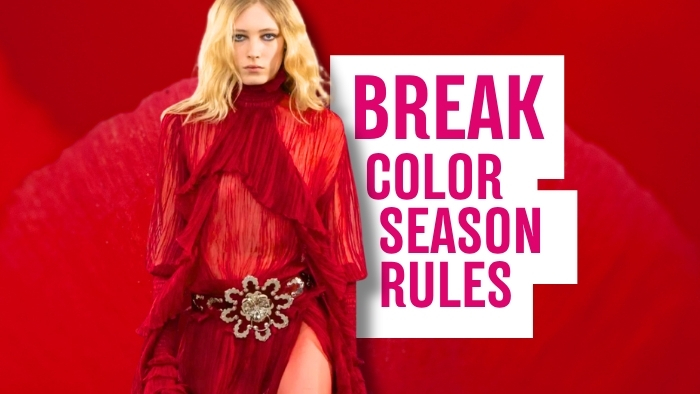
A manifesto for the ones who refuse to be color-coded.
Burn the rulebook (but keep the matches)
Seasonal Color Analysis, the polite fashion gospel of color harmony, tells you that your appearance must obey biology. You are classified like a mood ring: spring, summer, autumn, winter. Each palette promises “balance” and “light.” It measures you by undertone, contrast, and brightness, reducing you to a fixed spectrum of acceptable shades. It preaches that harmony equals beauty, and that deviation equals error. But who decided that? The antisystem tears this down. It says you don’t have to dress like your undertone; you can dress like your mind. It’s about deliberate dissonance—dressing against the predicted outcome and letting the clash speak.
Instead of following the comfortable mathematics of colorimetry, the antisystem uses contradiction as expression. The goal is not to flatter your complexion but to express your consciousness. Where the system seeks invisibility—melting you into “natural” harmony—the antisystem amplifies your personality until it hums.
If the traditional method says “avoid what washes you out,” the antisystem whispers “wear what unsettles you.” Because tension is magnetic. Because not everyone wants to look soft and blended. Some of us want to look like an idea, not a product.
Ready to rebel intelligently? You can take my test here to discover your own psychological color axis. Forget about warm, cool, muted, or bright—think about how you think. Your emotions, your rhythm, your rebellion.
Dress by Psychology, Not Pigment
Color is language. In the antisystem, it’s not decorative—it’s declarative. Instead of asking “what suits me?”, ask “what says me?”. Your clothing becomes a psychological mirror, not a seasonal cage. We build from essences—internal archetypes that express your way of existing in color. They’re not dictated by skin tone, but by energy, motion, and emotional geometry. You can also find your essence and discover your psychological colors here.
The Essences and Their Color Logic
Below you’ll find the emotional signatures of each essence. Each one describes how color behaves when guided by psychology rather than pigment theory.
Dramatic Essence
Dark, vivid neutrals. Think jet black, toxic green, laser red. Colors that hit like noise, not melody. Wear structure, sharpness, and minimal decoration. You are tension in motion—a storm, not a sunset.
Ethereal Essence
Light, floating tones—mist, cloud, pearl, seafoam. Soft, continuous transitions and gentle light. You dissolve outlines and reject heaviness. You wear air.
Natural Essence
Earthy, tactile tones—tobacco, olive, clay, muted blue. You move with grounded flow, never rigid, never glossy. It’s rebellion through comfort and authenticity.
Naive Essence
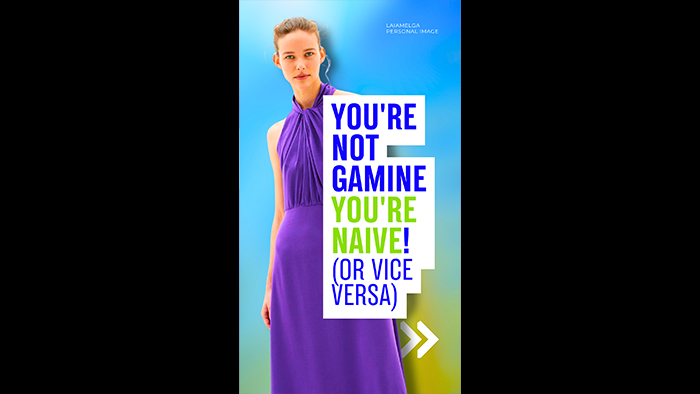
Candy colors—sherbet, butter yellow, apple green. Playful, luminous, deliberately sweet. Your color story is irony disguised as innocence. You don’t chase maturity; you weaponize joy.
Romantic Essence
Carmine, coral, and molten red. Sensuality with control. Your palette burns but never screams. You express power through curve, not through angle. Your rebellion is in excess and emotion.
Gamine Essence
Primary colors, color-blocking, bold contrast. Nothing blended, everything crisp and defiant. You are youth weaponized—cheerful anarchy in motion.
Classic Essence
Stone, navy, camel, ivory. Balance elevated to art. Your rebellion is in precision and refusal of trend. Stillness as protest. Elegance as confrontation.
How to Rebel, Precisely
- Pick your essence, not your season. Your mind dictates the palette.
- Play with contrast: low for subtle rebellion, high for chaos and presence.
- Invert the “flattering” logic: if it drains your color, let it feed your narrative.
- Change texture before hue. Matte vs. gloss rewrites the temperature story.
- Let silhouette speak first; color follows intent.
- Break one rule, then another. Keep breaking until you look like a sentence that can’t be finished.
The antisystem is not anti-beauty. It’s beauty in protest. It’s the art of making fashion conscious again—turning clothing into manifesto. When you stop dressing to please the mirror, you start dressing to express your mind.
Take the Test
Discover your essence and anti-seasonal palette here. Dress for your psychology—because anything else is costume. Color becomes autobiography when it’s chosen, not assigned.